About the project
Adapting drained forests to future climates
Developing adaptive drainage solutions to sustain forest productivity, protect water quality, and support biodiversity under climate change.
Why
Between the 1950s and 1980s, a large part of the boreal and hemiboreal forest was drained. Drainage has increased forest productivity for decades, but under a warmer and potentially drier climate it may also increase drought stress by accelerating soil drying. Drainage also affects downstream water conditions and the wetland-dependent species associated with ditch networks. Empirical data on how declining soil moisture affects these forests, and on which practices best reduce the impacts, are still limited.
What we test
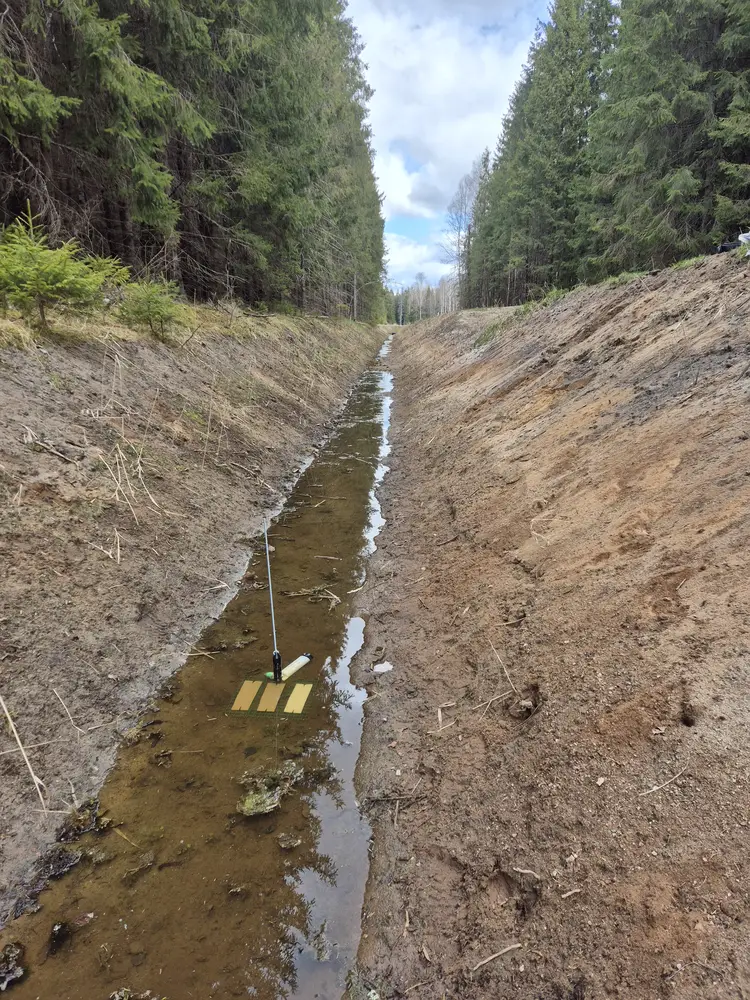
Adaptive, or “smart”, drainage uses adjustable structures to regulate water levels in ditch networks. Water can be retained during dry periods and released during wet periods, helping forests maintain access to moisture while preserving drainage capacity when needed. Adaptive drainage has been successfully applied in agriculture to regulate water retention and nutrient losses, but its potential in forests remains largely untested.
How
We combine hydrological modelling with a before-after-control-impact experiment at 12 drained forest sites in Estonia and Latvia, chosen for their drought sensitivity and drainage networks. Adaptive drainage structures will be installed at six of them, three in each country. The plots were set up in 2025 with RMK and the Latvian Forest Research Station.
Over four years, we follow groundwater, tree growth, water quality, and life in and around the ditches, including aquatic primary production and the insects that emerge from them. The project integrates hydrology, tree physiology, water quality, and aquatic ecology to evaluate ecosystem-wide responses to adaptive drainage.
Work packages
- WP1Drought-risk mappingIdentify drained hemiboreal forests that are vulnerable to drought.
- WP2HydrologyModel and measure site hydrology to guide the design and placement of adaptive drainage.
- WP3Water qualityQuantify the effects on nutrient and sediment retention.
- WP4Tree growth and forest productivityInvestigate the effects on tree growth and forest productivity.
- WP5Aquatic primary productionEvaluate the effects on primary production in the ditches.
- WP6Aquatic and semi-aquatic biodiversityAssess the effects on aquatic invertebrates, amphibians and the emerging insects that feed terrestrial food webs.
- WP7Synthesis and outreachCombine the results into practical guidance for forest managers, policymakers and researchers.